This year at SDinGOV, I’ve really enjoyed the opportunity to catch up with so many people in person, more than the talks if I’m honest. I was there the 3 days and got to chat with many current and ex colleagues. Out of all the conferences I attend, this one is where I get to see people in my field of work: designing for government. I’m sharing my highlights in this post.
Around the talks
I work mostly remotely, so even though I had met many of them in person before, there were still quite a few people from the DWP service design community I had never met face to face so that was really nice, and we got to know each other better. Unfortunately, I could not attend my friend Angela’s workshop, as she was presenting at the same time as me, but we had a few good chats over the 3 days.
As well as people I already knew I met a few new ones as well. The first evening, the social event was a ceilidh. This was great.The food was really good too and it looks like people were enjoying themselves. SDinGOV posted a short video on LinkedIn of it.
Food
Food is not easy for me since I was diagnosed with diabetes last year, but my blood sugar is under control now. The organisers of the event – Software Acumen – and my friend Jen who was the chair this year, have been really helpful, telling me what would be available ahead of the event and making sure there were fruits and other things I could eat at the various meals and breaks. I’ve really appreciate that. Do contact the organisers if you have your own needs as they really try to do what’s best for you.
Lightning talks
I’ve always enjoyed lightning talks, because within an hour, you can hear quite a few talks, very different in style and speakers have to be very really clear about the point they want to put across. But this year it was even better for me, because 2 of my colleagues gave it a go, even though they had not planned to do so when they came to the conference. I suggested it on the morning of the first day and they went on with it. They did great and I was really proud of them:
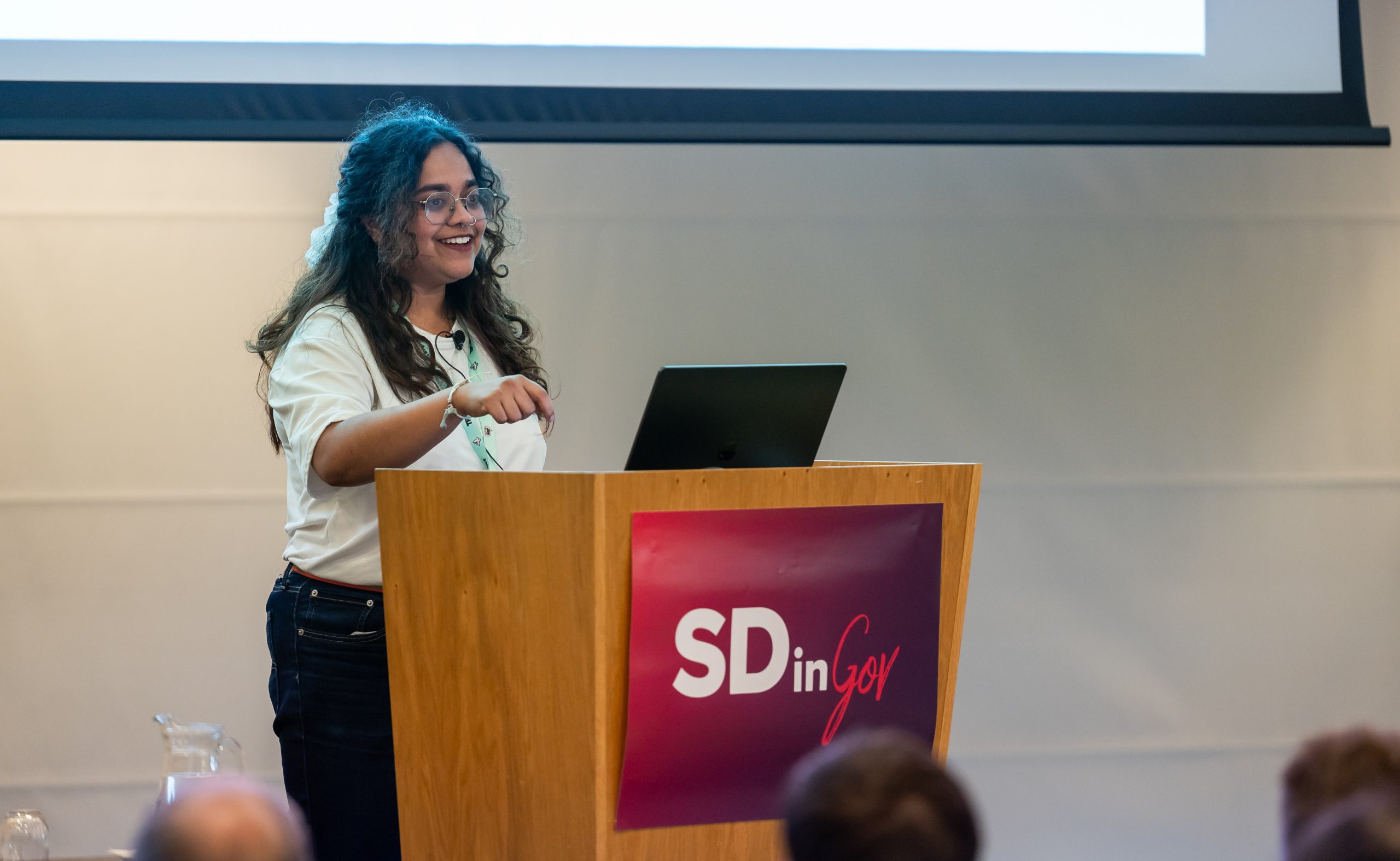
Bahana talked about her experience while working on a part of a live service and what led to her pushing others to define a vision for the whole service with her and not just for her part of it. She explained all this very clearly in 6 minutes, engaging people, with some of them coming at the end to ask her about her work.
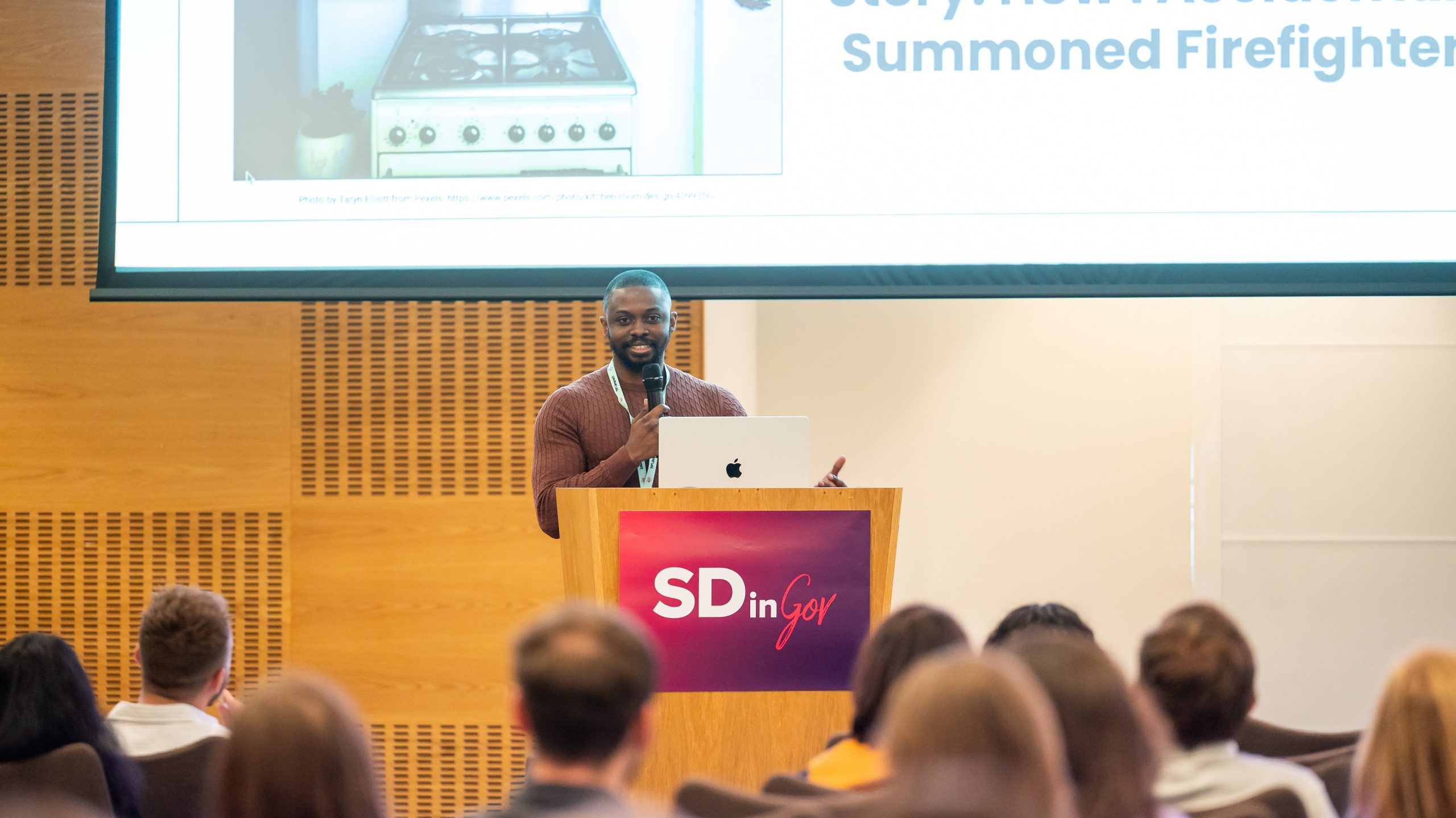
Kola‘s talk was very different: he used a personal experience to tell a story, then used some interaction to engage the audience and eventually made his point about why ethnographic research is important. All this in 5 min and a good sense of humour.
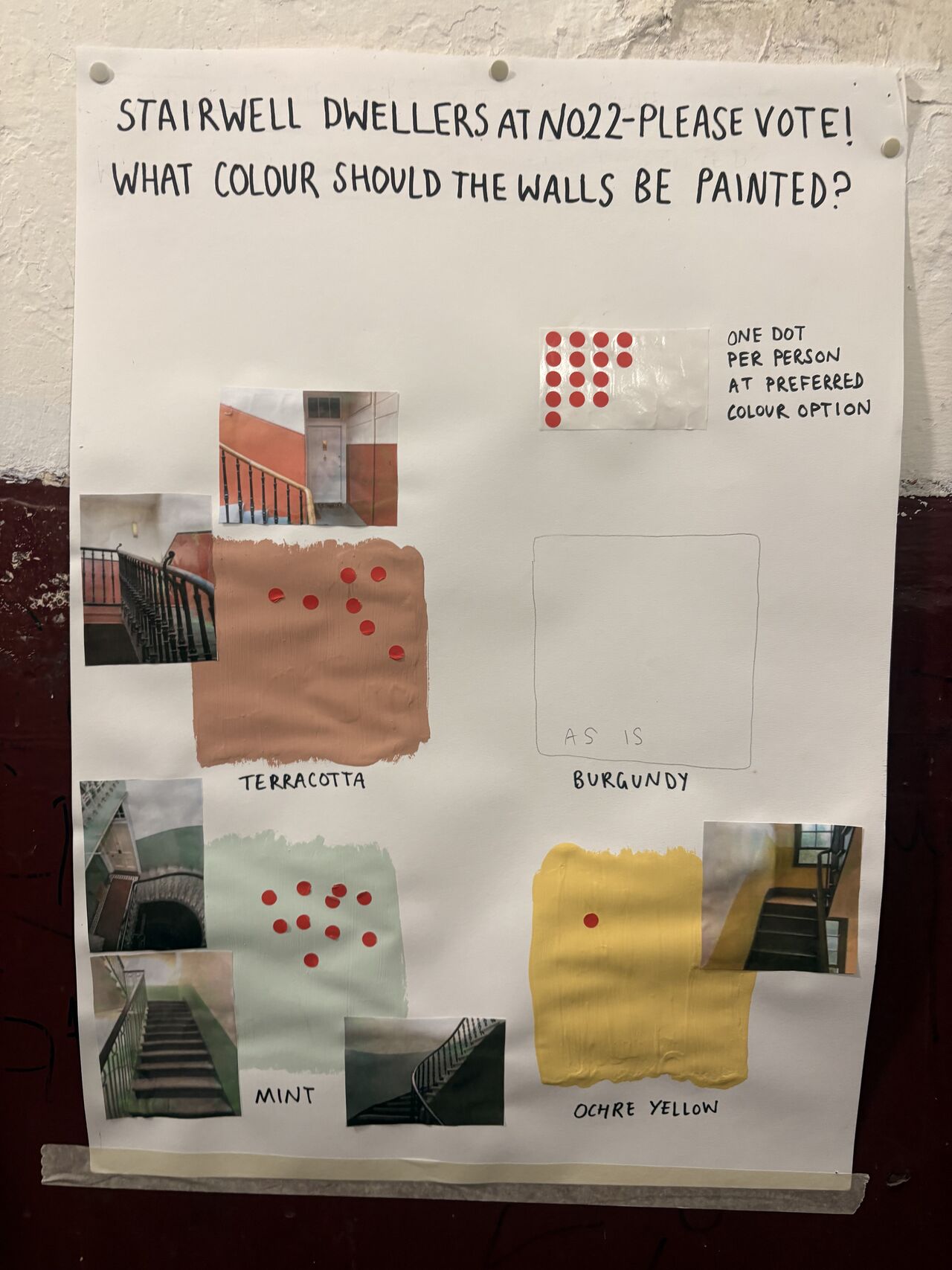
I do not know Dr Marion Lean, but she made a really good lightning talk too, using her designer’s experience to improve her tenement stairwell, build trust, encourage collaboration, and improve the shared space with others living there. It was very well delivered and a good illustration of co-design principles in practice.
Tempted by public speaking?
This is a great format to make a start. Lightning talks are brief – usually between 5 and 10 min – so you need to make your point clearly and get rid of non-critical information. The audience will be more attentive as a result.
Like I told Kola and Bahana: worse case scenario: “people will only be bored for 5 min and will forget everything about it”. At least that’s what I was telling myself the first time I submitted one.
Care for the public: trauma-informed service design – Rachael Dietkus
Rachael was the first keynote speaker announced for the conference. I was really happy to see this as I had heard her talk before, so I knew it would be good and I wasn’t disappointed. You can access the Care for public slides as a PDF (5.4 MB).
This was recorded, so I really recommend watching it when it will be available. I will only mention what resonated the most for me in that talk.
As stated in the programme, it was “a call to action for designers, policymakers, and public leaders to centre care at every decision-making level. To truly serve the public, we must learn how to care for the public.”
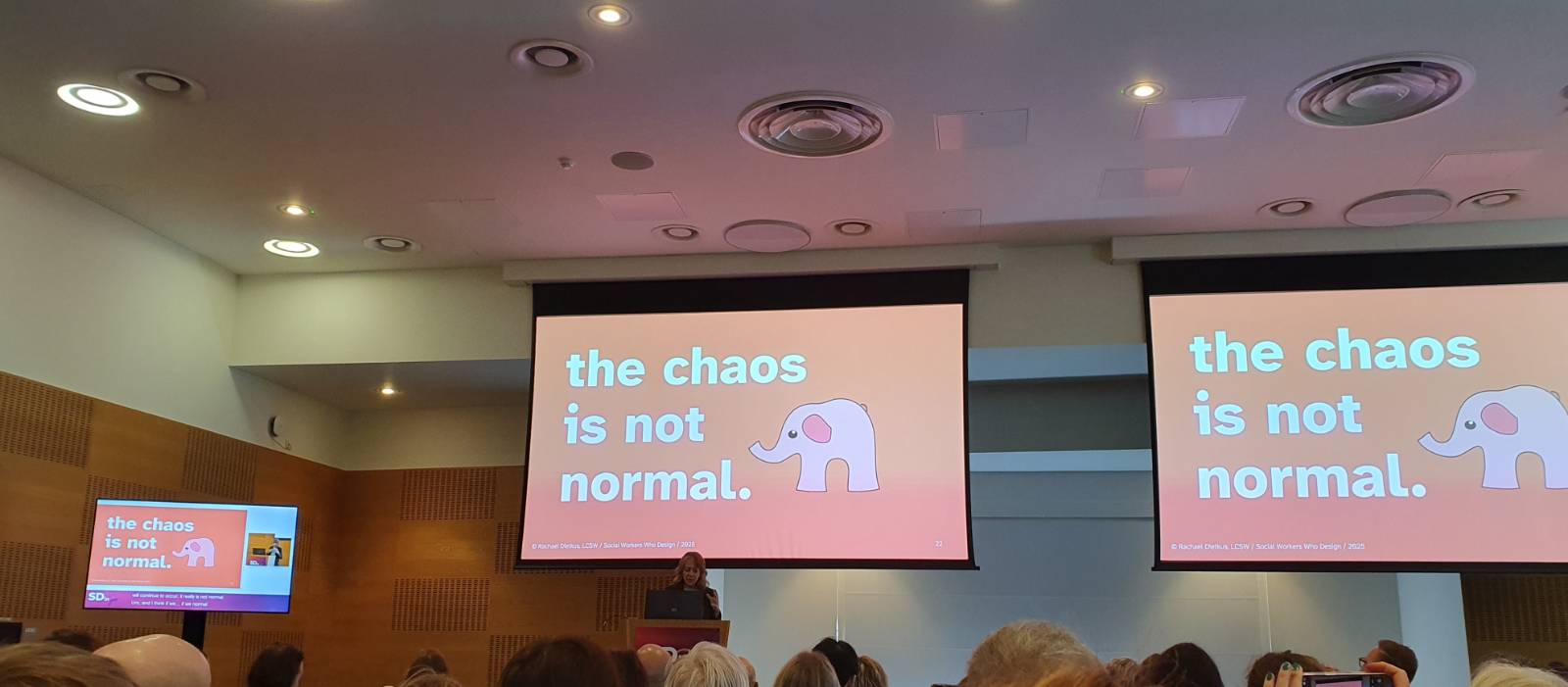
She reminded us that the current chaos is not normal, and it felt good to hear this.
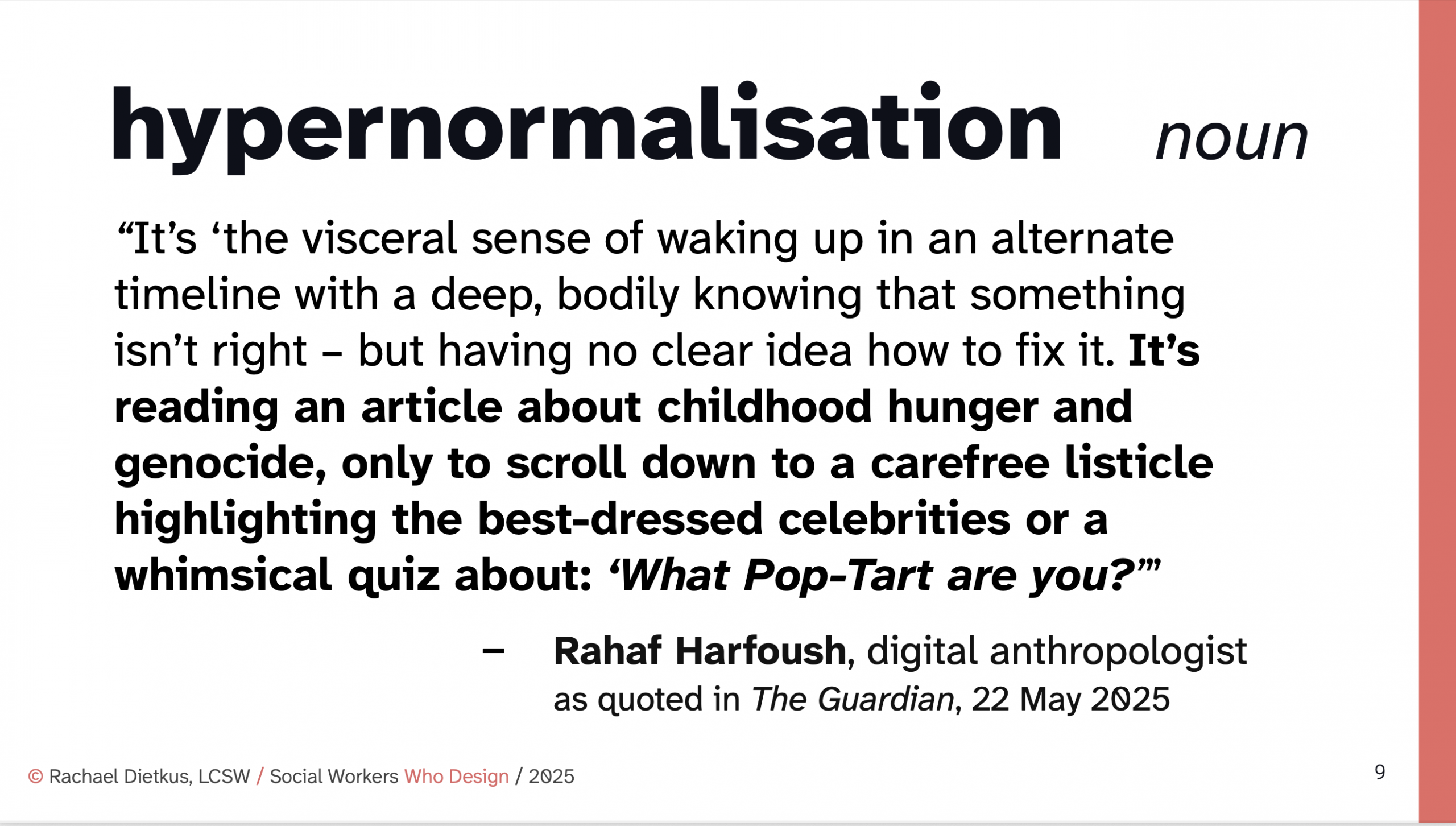
She used a quote to illustrate what ‘hypernormalisation’ is, and this really resonated with my experience of reading the news these days:
“It’s reading an article about childhood hunger and genocide, only to scroll down to a carefree listicle highlighting the best-dressed celebrities or a whimsical quiz about: ‘What Pop-Tart are you?’”
Rahaf Harfoush
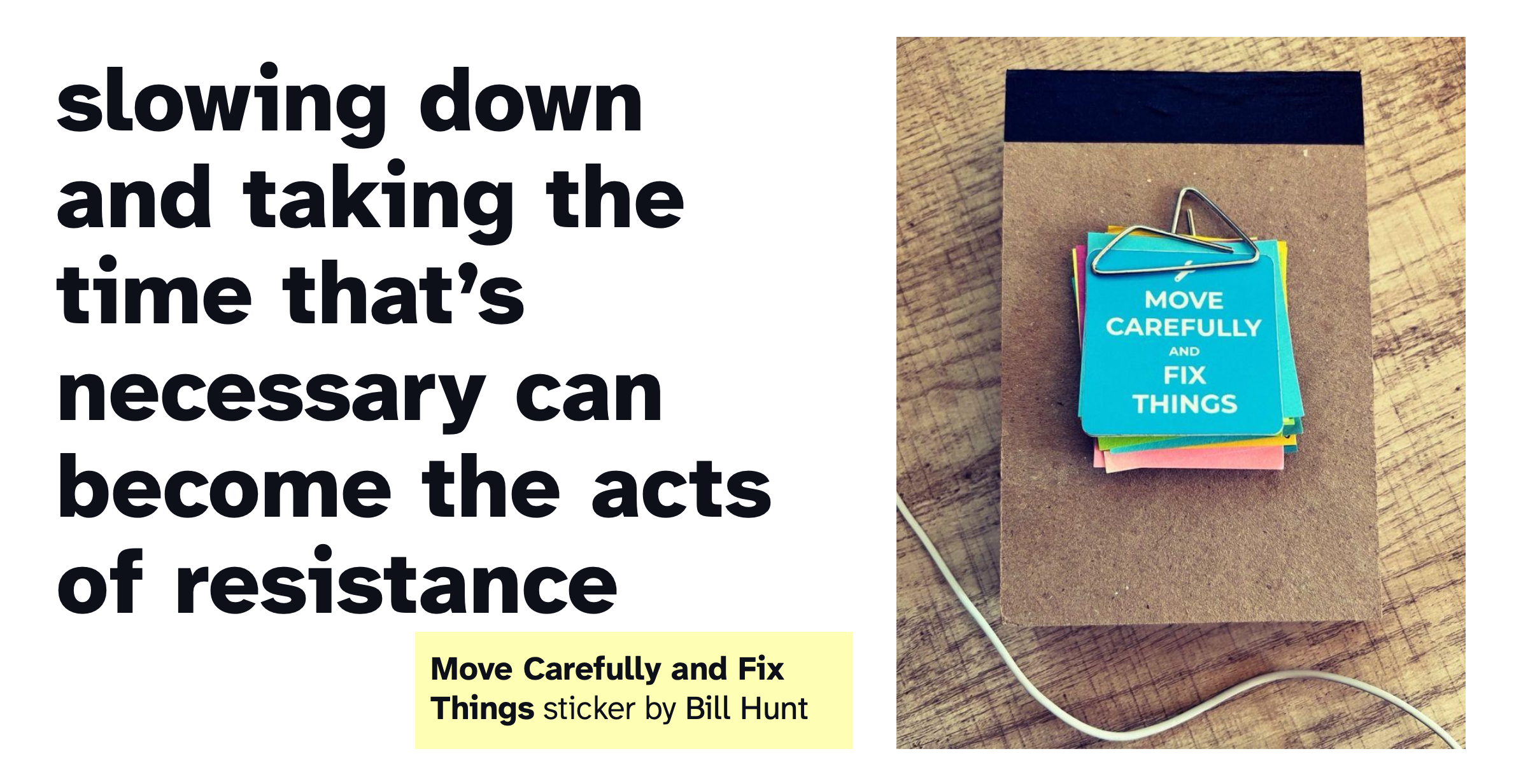
She invited us to slow down, reflects and gave us 5 simple questions to ask yourself when you’re making a decision:
- does this align with my values?
- Who benefits? who is harmed?
- Could I justify this decision publicly?
- are they alternatives that centre care and fairness?
- what accountability, visibility and responsibility measure are in place?
These are excellent questions for yourself, but it could also help you push back on some decisions made, not by you, but by your team or higher up. You could ask them: “Could you justify this decision publicly”? I’ve been on a few projects where there is no way we could have justify publicly decisions that were made, not by the team but by higher stakeholders. I’m not sure asking them would have changed their mind but at least it would have forced people to really aknowledge for themselves that it was the wrong thing to do. Personally, when I feel there is nothing in my power to change things, I do not want to let people get away with it too easily.
Rachael started a Design care newsletter, you can register here.
You might be eligible (we think, probably) – designing personalised vaccine services in the NHS – Caroline Finucane and Gabe Fender
This talk was excellent: it was very well delivered, engaging, interactive, fun, and getting a few points across really well. If the slides are shared, it will be on the SDinGOV page for the talk ‘You might be eligible‘. Caroline and Gabe used an interactive app on screen to run us through some scenarios depending on what people in the audience were answering. They used a ‘Family Fortune’ game to make us think of reasons why people might not vaccinate their children.
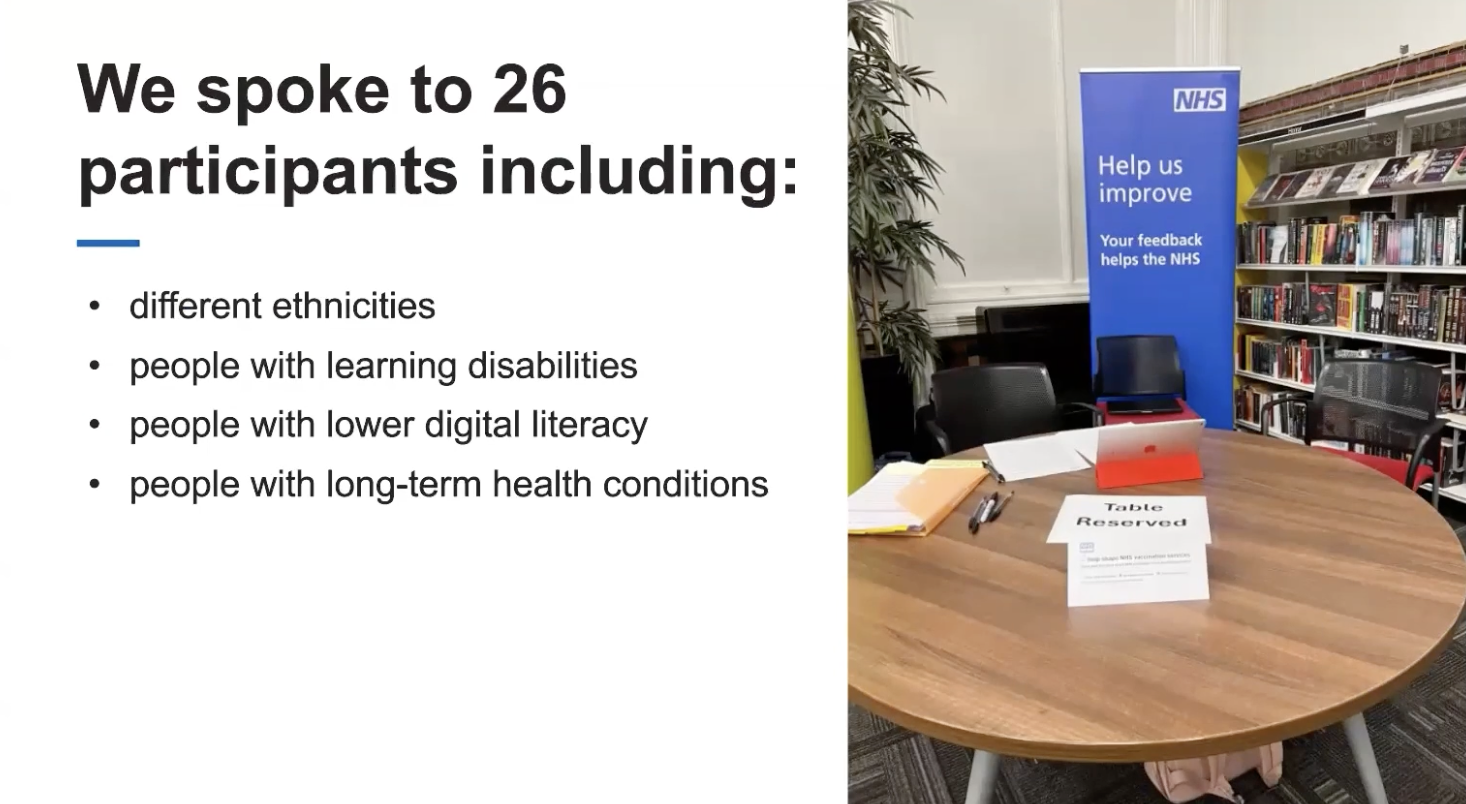
They took us through their thoughts process while looking for research participants who were pregnant individuals, with English not being their first language and when a person called “Martin” answered. They had a few doubts and it would have been easy to dismiss that potential participant. The way they explained it was really good because they were taking us with them, keeping us thinking at every step until the interview. It turned out that Martin was a person who was going to translate for the person who was indeed pregnant.
It was a very good illustration of one of their key learnings: “to recruit for diversity and inclusivity, we need to be aware of our own biases”
They shared a link to Digital prevention services design history that you might want to check.
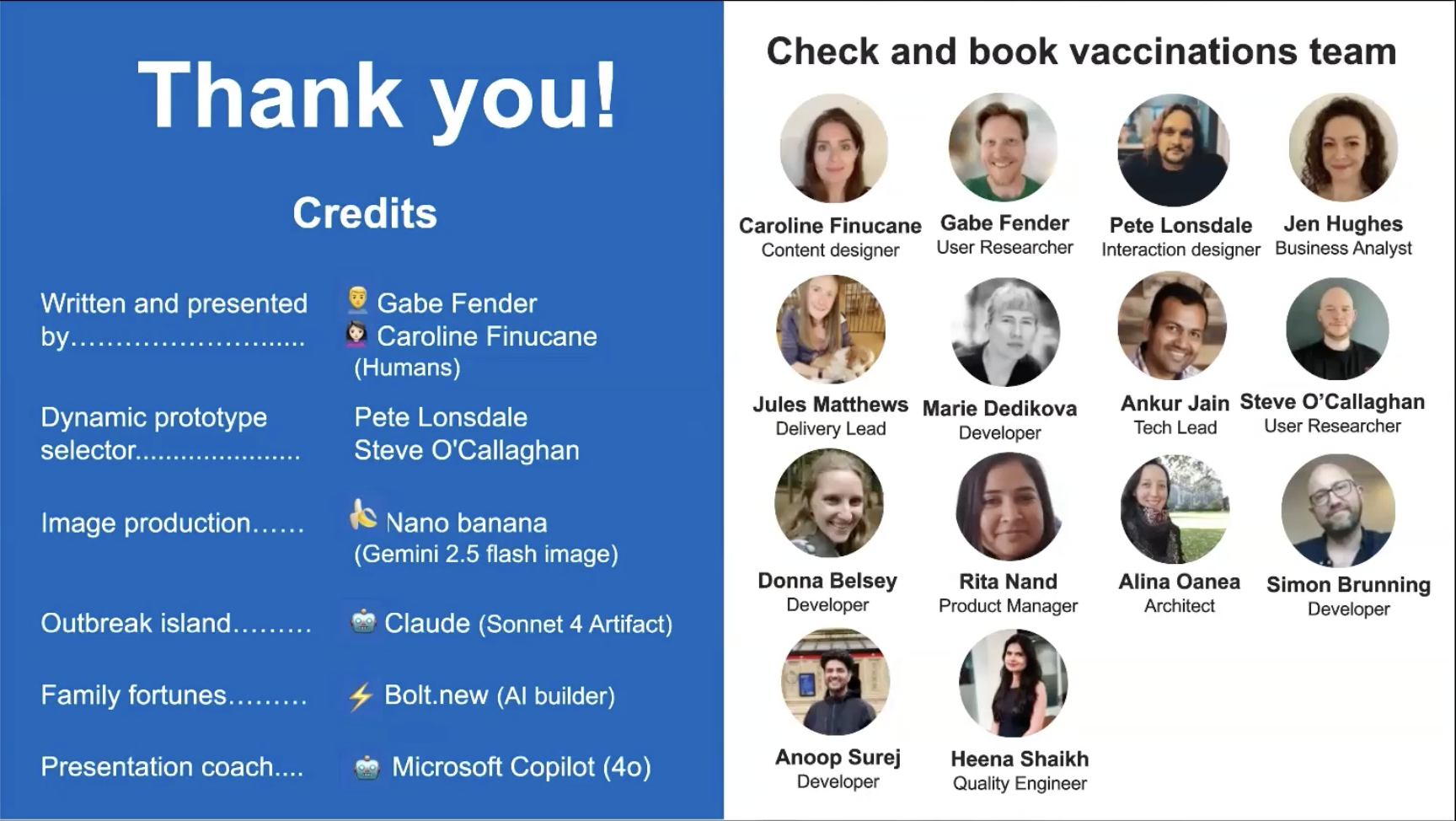
At the end of the talk, they had a slide with photos and names of all the people who had contributed to that piece of work and elements of the presentation. It was great to see that acknowledgement.
SOS (save our services): how design can survive and thrive in the era of government efficiency
survical for uncertain times – Martha Edwards
I hope the slides will eventually be shared on the SDinGOV page for the talk SOS (save our services). It was recorded too and I really recommend this talk.
Martha started by showing the timeline of events in the US and in Canada where she worked at the time when she submitted the talk. It was covering the US elections as well as Canadians ones. It’s not that long ago, and yet seeing that timeline reminded me of how things were unfolding back then. It was echoeing many feelings from Rachael’s talk early that day.
She gave tips to navigate political shifts and uncertainty:
- Stay calm (panic is contagious)
- Assess the situation (before you react) We can’t win support from people high up if they feel they are at risk or feel like you are blaming them
- Have a plan you can follow – “you can’t stay calm if you keep going around trying to find what to do next”: so you need plans, checklists and experience
- Look around, go beyond what’s in front of you – navigating means learning to understand. It’s important to create more space for relating
- Build alliances – example, kitchen in the fire station: place where people build trust: “relation can make or break trust”
- Use what you have at hand
- Make sure they can find you – if someone wanted to take your work forward, would they know where to look? You need to take the time and have the courage to share your work
Neurodivergent design thinking, to create inclusive recruitment – David Hopkins and Ollie Sweetman
Their talk was really interesting. They presented the work they have been doing as part of a cross-government working group looking at possible improvements for neurodivergent people in the workplace. You can access their slides as a PowerPoint file (15.3 MB). In this deck, slide 8 has an interesting diagram showing what people may struggle with depending on their neurodiversity conditions, but also what their strengths might be. This is always great to see because neurodivergence is too often framed as a negative, or a ‘disorder’ but actually, there are a lot of strengths too which can make them excellent candidates for the job you are recruiting for if you allow them to showcase their potential and their experience in the right way.
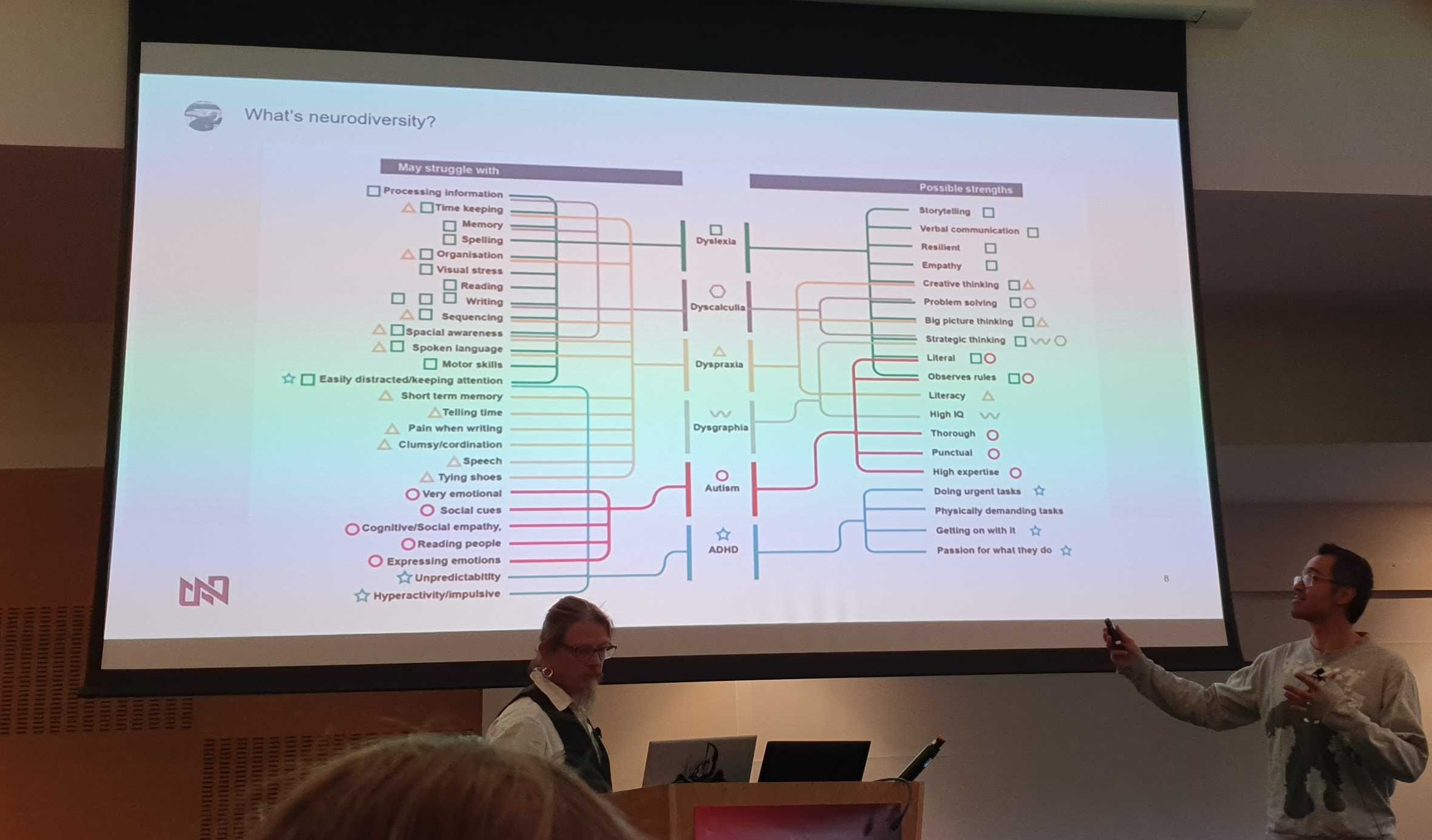
They played back research findings showing that quite often both the vacancy holders and neurodivergent colleagues didn’t understood reasonable adjustments during the recruitment process.
I’ve recently when through the recruiting process for the civil service and learned a lot in this session. For example, you can ask for reasonnable adujstments, even if you don’t have a diagnosis for your neurodivergent condition(s) . Even right at the start of the process when you are making the application, you could ask for more time to apply for example. But most people do not know about this.
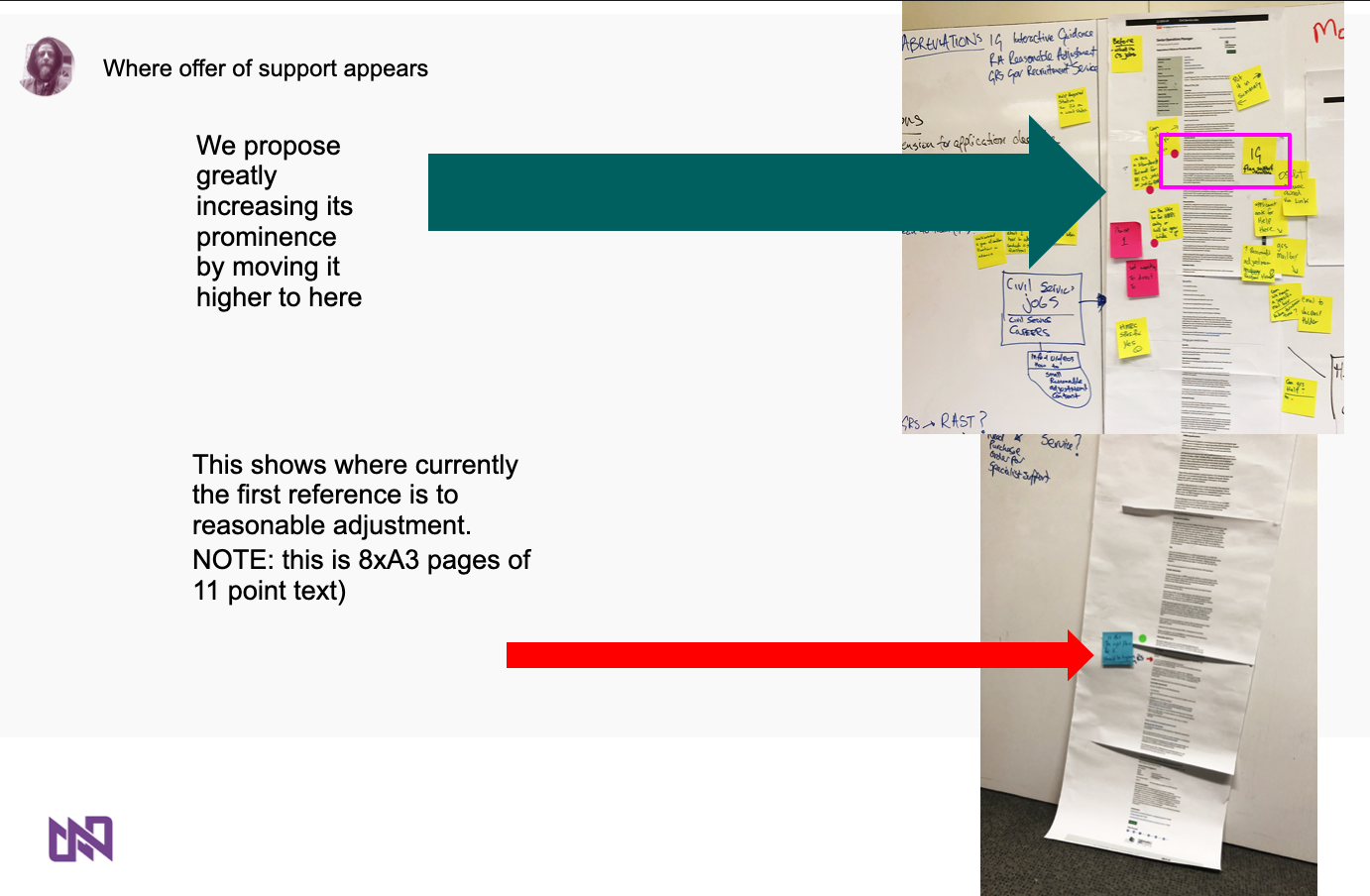
They have been prototyping a reasonable adjustment tool in line with universal design principles.The tool matches applicants’ support needs with reasonable adjustments at interview stages. It also informs vacancy holders of their responsibility, ensuring requests are made and implemented at the right time.
The talk was recorded so if you’re interested by this topic, you should watch. You can get in touch with David and Ollie if you would like to get involved (contact details in the deck at the end).
To learn more about reasonable adjustements, 2 links that David had provided me outside of this talk:
- What is reasonable? – by the Equality and Human Rights Commission (EHRC)
- Reasonable adjustments at work, Adjustments for neurodiversity – by ACAS
Redefining vulnerability through the lens of Consumer Duty – Katherine Snow and Lucy Barrett
This was a nice workshop, exploring how vulnerability can be experienced by anyone. They presented their work, and then put us in groups to think of the meaning of vulnerability and looking for alternative language.
They showed us new ways of thinking about ‘vulnerability’:
- Anyone can be vulnerable at anytime. Support needs to be accessible at all the times and to everyone
- Vunerability is an evolving set of needs, not a fixed state and no one’s situation is the same
- Terminology is holding back organisations and users
- There are universal good outcomes and universal barriers to access and safety
Personally, I do not speak about vunerable people, but about people in vulnerable situations. If you are curious about this, Helen Fisher has a blog post ‘Defining vulnerability’ about her work with Katherine on this.
How a service designer can contribute to accessibility
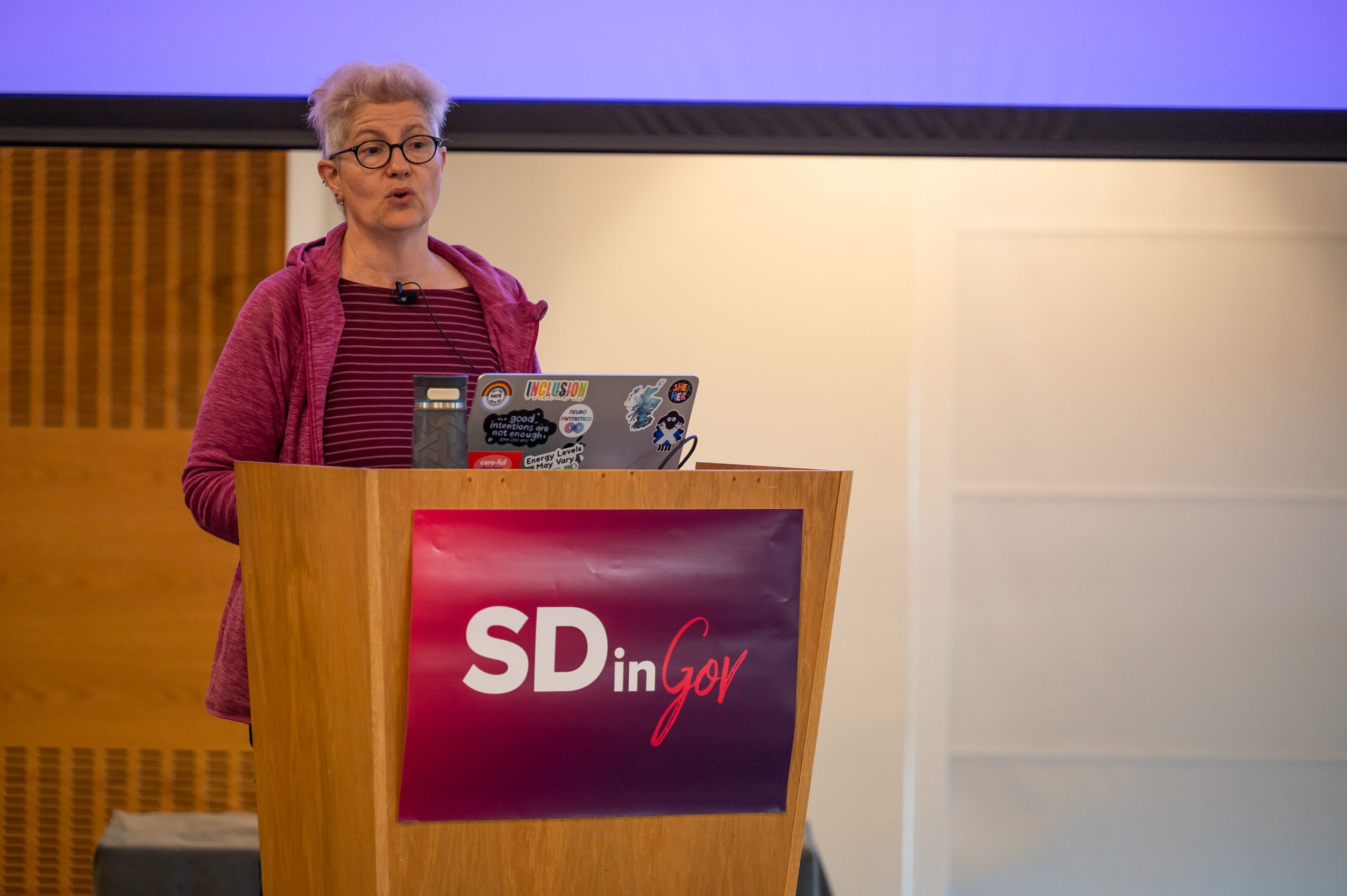
This was my talk this year. You can find all the material, including the slides in various formats on this page. You can watch a recording of this session on Vimeo.
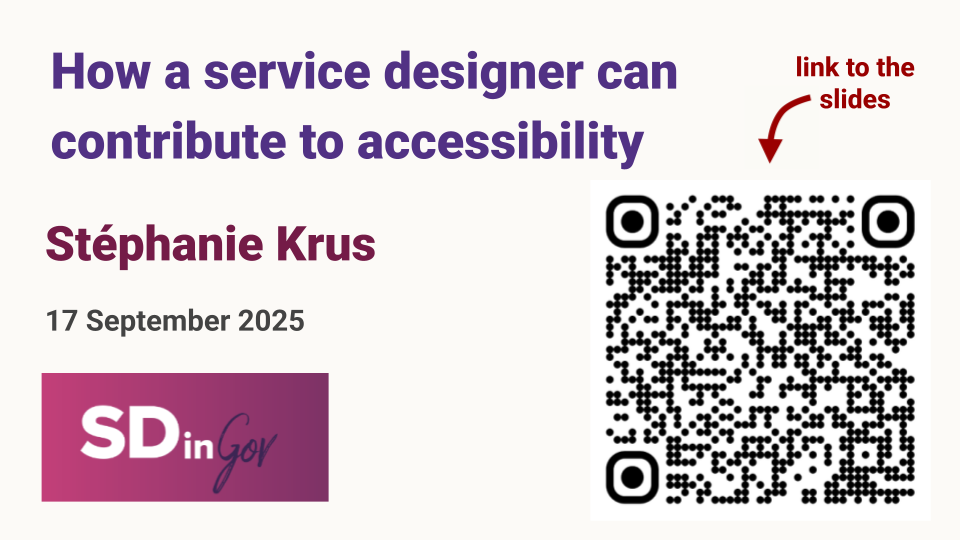
To make sure everyone could access the slides if they wanted to, I’ve put a QR code on the first slide displayed while people wait for the talk to start. A few people told me they appreciated this.
My talk was about accessibility, but what many seem to take from it was the part about creating a text description of complex visual mappings and using that alternative version with policy and ops teams. It seems to be more engaging than the visual mapping for them as it’s a more familiar format.
I’ve written a blog post about it to expend on this if you’re interested: Helping people to engage with your mappings
I did have a few people coming after my talk and saying this made them feel they could make a start and change their practice, which is exactly why I give theses talks. So was really happy about this.
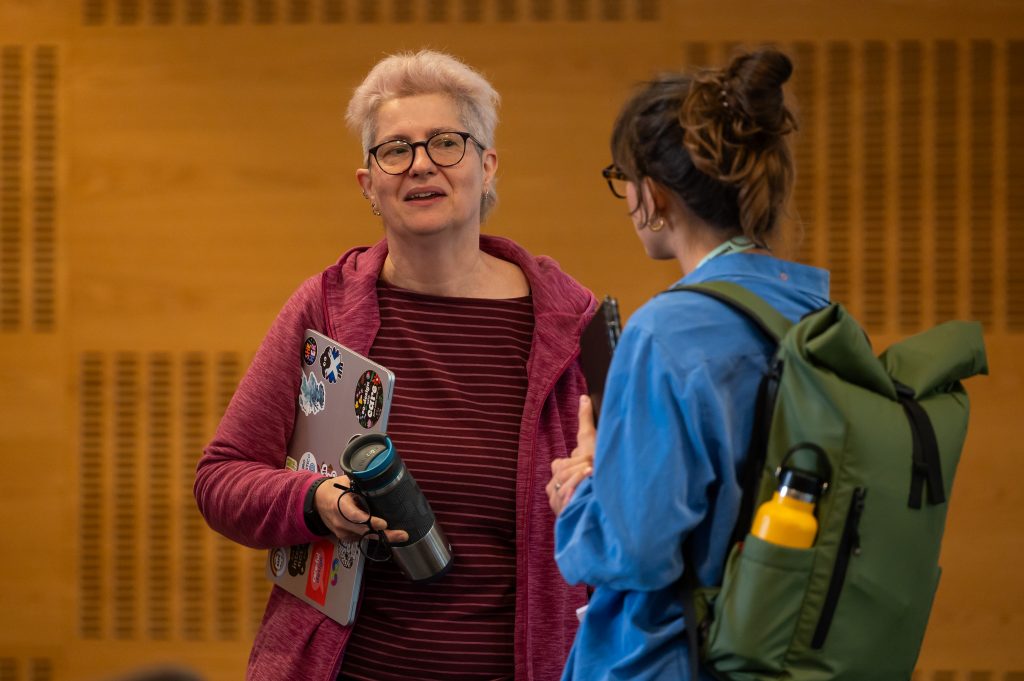
Not many slides to share this year
I usually try to share slides and more in these summaries, but this year I do not have many to share. Some talks like mine were recorded so at some point, I might be able to share that soon.
Edit 23/12/2025: You can now watch some of the sessions (including mine) on Vimeo
Slides
- How to exit our service design Groundhog Day experience? (PDF 2.5MB) Martin Jordan and Kara Kane
- Sprinting toward better consent processes and more inclusive research (PowerPoint 16MB) – Claire Craig, Mansoor Mir, and Thomas Sweetland-Michie
- Policy Design at pace (PowerPoint 24MB) – James Dotti and Astrid van Waveren
- From awareness to action – Co-creating a framework for trauma-informed digital services (PDF 750KB) – Dr Priscilla Chueng-Nainby, Dr Angela Orviz, Bukola Jolugbo and Joan Herlinger
- The human alternative and how design can help (PDF 22.2MB) – James Plunkett
- Living beyond cancer: designing to cope with long term survivorship challenges through creativity, sensitivity and care (PDF 20/2MB) – Komal Pahwa
- No more content vomit: how to train like a service designer, by Jo Carter and Katie Driver, the Google slides from their workshop
Slides and more
The slides from Share and reuse by design (PDF 8.1MB), by Nikola Goger, Rob McCarthy and Martin Ford-Downes, some links if you are interested in Service Patterns, h:
- Developing service patterns – reusable designs for building government services (GOV.UKblog post)
- Apply’ service pattern proof of concept
- ‘Appointments’ service pattern proof of concept
- GOV Reuse library
- they have a write up of their talk in 5 parts: Write-up: “Share & Reuse by Design” — Talk at SDinGov 2025
Other sources
A write-up on Designing for dignity: Ryan Haney on civic design and the burden/power ratio – by Nia Campbell
And a blog post for the workshop Garbage in, garbage out by Caroline Jarrett